
Is There Any Truth to a High Mortality Rate Among Young Adults in the United States?
Part 1 of a 3-Part Series
Introduction
For decades, young adulthood has been viewed as a time of strength, resilience, and low risk for serious health outcomes. However, in recent years, troubling data has challenged this assumption. Headlines have increasingly pointed to rising death rates among young adults in the United States, sparking public concern and professional alarm within the healthcare community (Centers for Disease Control and Prevention [CDC], 2023; Woolf & Schoomaker, 2019).
So the question must be asked: Is there truly a high and rising mortality rate among young adults in the U.S.—or is this a misunderstanding of the data? The answer, backed by years of national statistics, is clear: the increase is real, significant, and demands urgent attention (Ahmad et al., 2023; Woolf et al., 2021).
What the Data Shows
National mortality data reveals a disturbing trend. After decades of improvement in life expectancy, death rates among young adults between the ages of approximately 25–44 began rising steadily after 2010, with a dramatic acceleration during the COVID-19 pandemic (Woolf & Schoomaker, 2019; Woolf et al., 2021).
Recent peer-reviewed research estimates that mortality among young adults is now approximately 70% higher than expected based on pre-2010 trends, representing millions of premature deaths that would likely not have occurred under earlier public health patterns (Ahmad et al., 2023; CDC, 2023).
While pandemic-related illness contributed to this increase, the rise did not begin with COVID-19—it simply intensified during those years. Even as infection-related deaths decline, overall young-adult mortality remains well above historical baselines (Woolf et al., 2021; CDC, 2023).
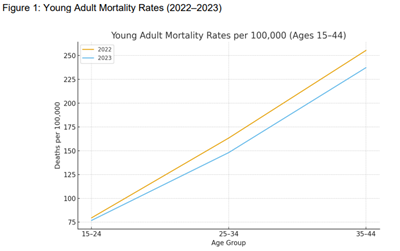
Figure 1. Young Adult Mortality Rates per 100,000 (Ages 15–44, 2022 vs. 2023)
Source: National Center for Health Statistics (NCHS), CDC
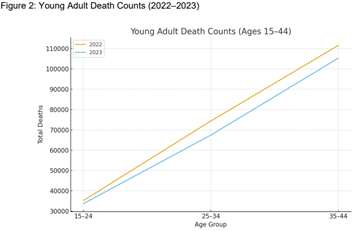
Figure 2. Young Adult Death Counts (Ages 15–44, 2022 vs. 2023)
Source: National Center for Health Statistics (NCHS), CDC
What Is Driving the Increase?
Unlike older populations where chronic disease dominates, young adult mortality is driven largely by preventable causes, including:
- Drug overdoses, especially opioids and synthetic fentanyl
- Suicide and mental health crises
- Unintentional injuries, including vehicle accidents
- Violence and firearm-related deaths (CDC, 2023)
Of these, drug poisoning now represents the single largest contributor to excess deaths among young adults (Ahmad et al., 2023; CDC, 2023). Mental health struggles, social isolation, economic instability, and reduced access to consistent care further amplify these risks (Woolf et al., 2021).
Unequal Impact Across Communities
The rise in young adult mortality is not evenly distributed. Certain populations have experienced disproportionately higher death rates, including:
- Communities of color
- Rural populations
- Economically disadvantaged regions
- Young adults without consistent access to primary and behavioral healthcare (CDC, 2023)
These disparities underscore the role of social determinants of health—including housing, employment, education, and healthcare access—in shaping survival outcomes (Woolf & Schoomaker, 2019; Woolf et al., 2021).
Why This Matters for Healthcare Leaders
For healthcare consultants, providers, administrators, and policymakers, this trend represents a system-level warning sign. Young adults are essential to the stability of the workforce, economy, and healthcare system itself. Increased mortality at this life stage affects:
- Employer health plans
- Community health systems
- Medicaid and public health budgets
- Emergency and behavioral health services
More importantly, these deaths are largely preventable, making inaction not only financially devastating—but also ethically unacceptable (CDC, 2023; Woolf & Schoomaker, 2019).
Conclusion
Yes—there is undeniable truth to the claim that young adults in the United States are dying at higher rates than in previous generations (Ahmad et al., 2023; CDC, 2023). This is not merely a statistical anomaly but a clear signal of systemic breakdowns in mental health support, substance-use prevention, injury prevention, and social infrastructure (Woolf et al., 2021).
In the next part of this series, we will explore exactly what is driving these deaths—and why overdose, suicide, and injury now dominate young adult mortality.
Healthcare leaders must act now.
If your organization is navigating behavioral health integration, population health strategy, or community risk reduction, our consultants can help you design sustainable, data-driven solutions.
Coming Next: Part 2 — “The Leading Causes Behind Rising Young Adult Deaths”
References
Ahmad, F. B., Anderson, R. N., & Miniño, A. (2023). Provisional mortality data—United States, 2022. National Center for Health Statistics.
Centers for Disease Control and Prevention. (2023). Deaths and mortality.
Woolf, S. H., & Schoomaker, H. (2019). Life expectancy and mortality rates in the United States, 1959–2017. JAMA, 322(20), 1996–2016.
Woolf, S. H., Masters, R. K., & Aron, L. Y. (2021). Effect of the COVID-19 pandemic on U.S. life expectancy. BMJ, 373, n1343.
